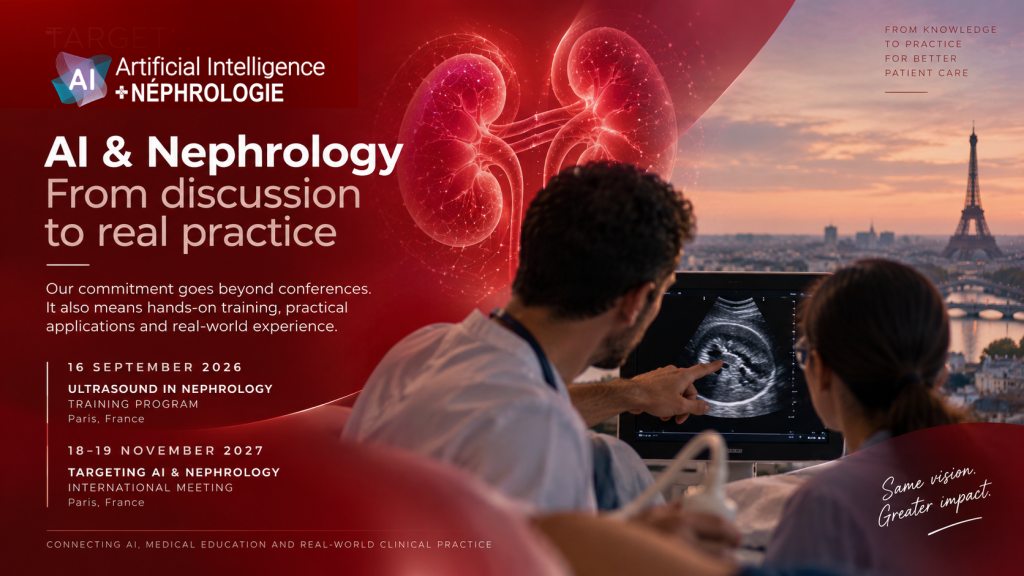
On September 16 in Paris, nephrologists will explore how emerging technologies, including AI-assisted ultrasound, can move from innovation to the physician’s hands.
Artificial intelligence is rapidly changing medicine. But for Targeting AI & Nephrology, the key question has always been more practical: how can AI actually help physicians in their daily clinical practice?
Over the past editions of our meetings, we have explored AI across kidney care—from prediction and transplantation to medical imaging, clinical data, generative AI and large language models. As early as 2023, our scientific program included a dedicated session on AI and medical imaging, including applications in ultrasound. More recently, our 2025 meeting introduced hands-on workshops designed to bring AI tools closer to clinical practice.
Now we are taking another step.
What can AI do in ultrasound?
On September 16, 2026, in Paris, the third Ultrasound in Nephrology training program will bring physicians together around point-of-care ultrasound and its practical applications in nephrology.
Kidneys and urinary tract, heart and lungs, vascular access, Doppler and volume assessment will be approached through hands-on, small-group training.
The day will also provide an opportunity to explore how a new generation of ultrasound technologies incorporating AI-assisted functions may support image acquisition, selected measurements and clinical workflow.
The purpose is not to suggest that AI can replace the physician or ultrasound expertise.
Quite the opposite.
We want to understand where AI can genuinely assist the nephrologist, where its limitations remain, and how these technologies should be integrated into medical training.
Putting the technology in physicians’ hands
For Prof. Marvin Edeas, this practical dimension is essential:
“We have spent several years discussing what AI could bring to nephrology. Now we also need to put these technologies into physicians’ hands and ask a simple question: does this really help us in clinical practice?”
Tomorrow’s initiative therefore goes beyond ultrasound training. It illustrates the broader direction of Targeting AI & Nephrology: connecting scientific discussion with education, experimentation and real-world clinical practice.
The initiative has progressively expanded from machine learning and predictive approaches to imaging, generative AI, LLMs and interactive clinical workshops. The next Targeting AI & Nephrology international meeting is already announced for November 18–19, 2027.
From AI innovation to clinical impact
AI in healthcare should not remain confined to algorithms, publications or conference presentations.
It must be confronted with clinical reality.
Can it make a complex technique easier to learn? Can it support image acquisition? Can it save physicians time? Can it provide useful information without weakening clinical reasoning? And, ultimately, can it contribute to better patient care?
These are the questions we want to continue exploring.
From generative AI to the ultrasound probe, our objective remains the same: to understand where AI can genuinely augment medicine—and where the physician must remain at the center.
Discover Targeting AI & Nephrology
September 16, 2026 — Paris, France
Ultrasound in Nephrology: Hands-on Training & Emerging Technologies